Email Security
Email remains the #1 entry point for cyberattacks—phishing, malware, ransomware, spoofing, and business email compromise (BEC) all start in the inbox. Our Email Security solution strengthens your network security by stopping threats before they reach users, protecting both inbound and outbound email, and reducing the risk of account takeover and data loss.
Whether you need cloud email security for Microsoft 365 email security or Google Workspace email security, or a modern secure email gateway for hybrid environments, we help you prevent attacks, enforce policy, and prove compliance—without slowing down your business.
Built for Modern Email Threats
Email is the easiest way for attackers to reach your people—and the hardest for busy teams to spot in time. Pair filtering with security awareness training and phishing tests to reduce click rates. Our Email Security layer blocks phishing attacks, malicious attachments, ransomware payloads, and business email compromise (BEC) attempts before they hit inboxes, while also protecting your domain from spoofing with DMARC, SPF, and DKIM. To validate exposure beyond the inbox, consider penetration testing.
What you get with our email security solution:
- Anti-phishing protection for impersonation, credential theft, and risky links
- Email malware protection with attachment scanning and sandboxing
- BEC protection to stop invoice fraud and account takeover-driven scams
- Spam filtering for business to cut noise and improve productivity
- Outbound email security options to reduce data loss and policy violations
Stop Email Threats at the Source
Advanced Anti-Phishing & Phishing Protection
Catch credential theft, impersonation, and lookalike domains with multi-layered anti-phishing controls:
- Real-time URL rewriting and time-of-click protection
- Brand and executive impersonation detection
- VIP and high-risk user protection
- AI-assisted detection for new and evolving phishing campaigns
Business Email Compromise (BEC) Protection
BEC attacks don’t always use malware—they use social engineering. Our BEC protection focuses on:
- Executive spoofing and supplier fraud prevention
- Payment redirection and invoice scam detection
- Conversation hijacking alerts
- Behavioral anomaly detection for unusual sender patterns
Email Malware Protection & Ransomware Defense
- Antivirus + sandbox detonation for suspicious files
- File-type controls (macros, archives, executable blocking)
- Ransomware email protection and outbreak containment
- Threat intelligence updates and automated quarantine actions
- If something bypasses email controls, endpoint protection / MDR helps contain it.
Spam Filtering for Business
Reduce inbox noise and improve productivity with high-accuracy email filtering:
- Adaptive spam filtering and bulk mail controls
- Graymail management (newsletters and promotions)
- Safe list / block list management and policy-based routing
Stop Email Threats at the Source
Advanced Anti-Phishing & Phishing Protection
Catch credential theft, impersonation, and lookalike domains with multi-layered anti-phishing controls:
- Real-time URL rewriting and time-of-click protection
- Brand and executive impersonation detection
- VIP and high-risk user protection
- AI-assisted detection for new and evolving phishing campaigns
Business Email Compromise (BEC) Protection
BEC attacks don’t always use malware—they use social engineering. Our BEC protection focuses on:
- Executive spoofing and supplier fraud prevention
- Payment redirection and invoice scam detection
- Conversation hijacking alerts
- Behavioral anomaly detection for unusual sender patterns
Email Malware Protection & Ransomware Defense
- Antivirus + sandbox detonation for suspicious files
- File-type controls (macros, archives, executable blocking)
- Ransomware email protection and outbreak containment
- Threat intelligence updates and automated quarantine actions
- If something bypasses email controls, endpoint protection / MDR helps contain it.
Spam Filtering for Business
Reduce inbox noise and improve productivity with high-accuracy email filtering:
- Adaptive spam filtering and bulk mail controls
- Graymail management (newsletters and promotions)
- Safe list / block list management and policy-based routing
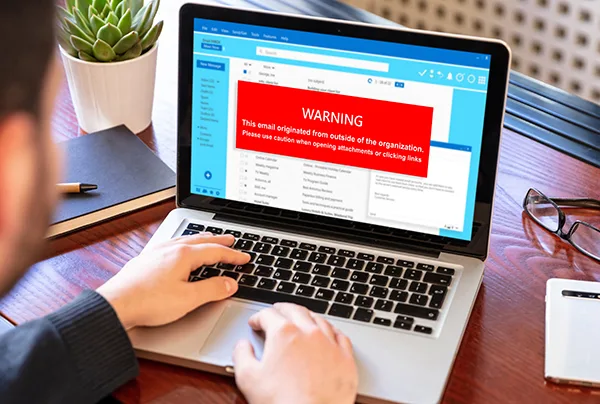
Domain Protection: DMARC, SPF, and DKIM
Prevent spoofing and protect your brand with authentication and enforcement:
- SPF configuration to authorize senders
- DKIM signing to validate message integrity
- DMARC policies (monitor, quarantine, reject)
- Reporting and insights to reduce phishing using your domain
If you’re searching for “DMARC setup,” “SPF DKIM DMARC,” or “stop email spoofing,” this is the foundation.
Secure Email Gateway or Cloud Email Security
Cloud Email Security (API or MX-based)
Ideal for Microsoft 365 and Google Workspace:
- Fast deployment with minimal infrastructure
- Scales automatically for distributed teams
- Central policy management and reporting
Secure Email Gateway (SEG)
Best for regulated or hybrid environments:
- Full control and customizable routing
- Advanced DLP and compliance workflows
- Integration with existing network security tools
Not sure which is right? Many organizations start with cloud email security and add gateway controls as needs mature.
We also run vulnerability assessments to uncover gaps across your environment.

Email Security FAQs
What is email security and why does my business need it?
Email security is the set of controls that protect your inbound and outbound email from phishing, malware, ransomware, spoofing, and business email compromise (BEC). Because email is the #1 entry point for cyberattacks, even one missed message can lead to account takeover, fraud, or data loss—so layered filtering plus user training is essential.
Doesn't Microsoft 365 or Google Workspace already protect my email?
Built-in filtering catches a lot of obvious spam and known malware, but it often misses targeted phishing, impersonation, and BEC attacks that rely on social engineering rather than malicious files. We add a layer of advanced anti-phishing, sandboxing, and impersonation detection on top of M365 or Google Workspace to close those gaps.
What is business email compromise (BEC), and how do you stop it?
BEC is a scam where attackers impersonate an executive, vendor, or trusted contact to trick employees into wiring money, changing payment details, or sharing data—usually without any malware. We defend against it with executive/supplier spoofing detection, payment-redirection and invoice-fraud alerts, conversation-hijacking warnings, and behavioral anomaly detection for unusual sender activity.
What are SPF, DKIM, and DMARC, and do I need all three?
They work together to stop attackers from spoofing your domain. SPF authorizes which servers can send mail for you, DKIM cryptographically signs messages to prove they weren’t altered, and DMARC tells receiving servers how to handle mail that fails those checks (monitor, quarantine, or reject). For full protection against spoofing, you want all three configured and enforced.
Should I choose cloud email security or a secure email gateway (SEG)?
Cloud email security (API or MX-based) deploys fast, scales easily, and is ideal for Microsoft 365 and Google Workspace environments. A secure email gateway offers full routing control, advanced DLP, and compliance workflows, making it a strong fit for regulated or hybrid setups. Many organizations start with cloud email security and add gateway controls as their needs grow.
Will email security slow down or block legitimate messages?
Modern filtering is tuned for high accuracy with low false positives. Suspicious attachments are detonated in a sandbox, graymail (newsletters/promotions) is sorted out, and you keep control through safe lists, block lists, and policy-based routing—so legitimate mail flows while threats are quarantined.
How does email security protect against ransomware and malicious attachments?
We combine antivirus scanning with sandbox detonation for suspicious files, file-type controls (blocking risky macros, archives, and executables), automated quarantine, and continuous threat-intelligence updates. If something slips past email controls, endpoint protection/MDR helps contain it.
Does email security replace security awareness training?
No—they complement each other. Filtering blocks the majority of threats, but training and simulated phishing tests lower the click rate on the attacks that get through. The strongest protection pairs technical controls with a well-trained team.
Can you protect outbound email and prevent data loss?
Yes. Outbound email security and data loss prevention (DLP) options help stop sensitive information from leaving your organization and reduce policy violations, while also protecting your sending reputation.